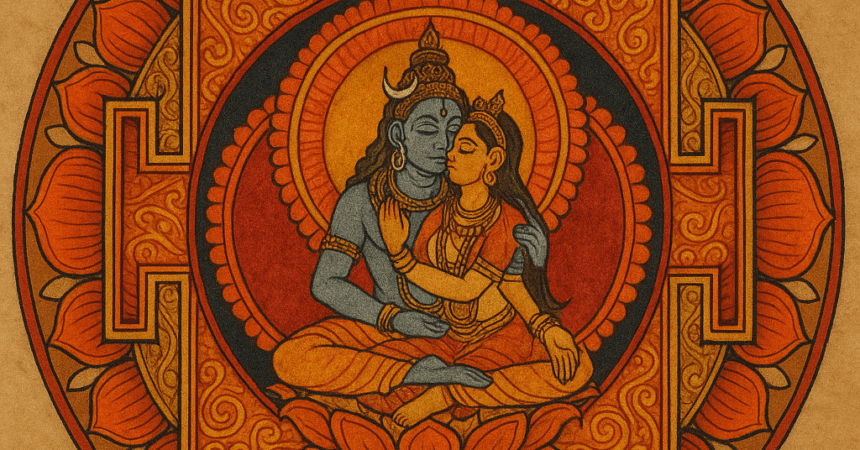
Immerse yourself in the heart of tantrism, this ancient path born in India, where «tantra» means web and expansion of consciousness. Much more than a simple sexual practice, it combines rituals, meditation and tantric yoga to awaken vital energy. Between masculine and feminine principles, sacred mantras and intimate connections, tantrism offers a holistic experience: a path towards oneself where body, mind and breath become one. Discover its origins, foundational texts and techniques to approach sacred sexuality differently and enrich your quest for meaning.
What is tantrism: definitions and etymology
What is the origin of the word «tantra» and what does it mean?
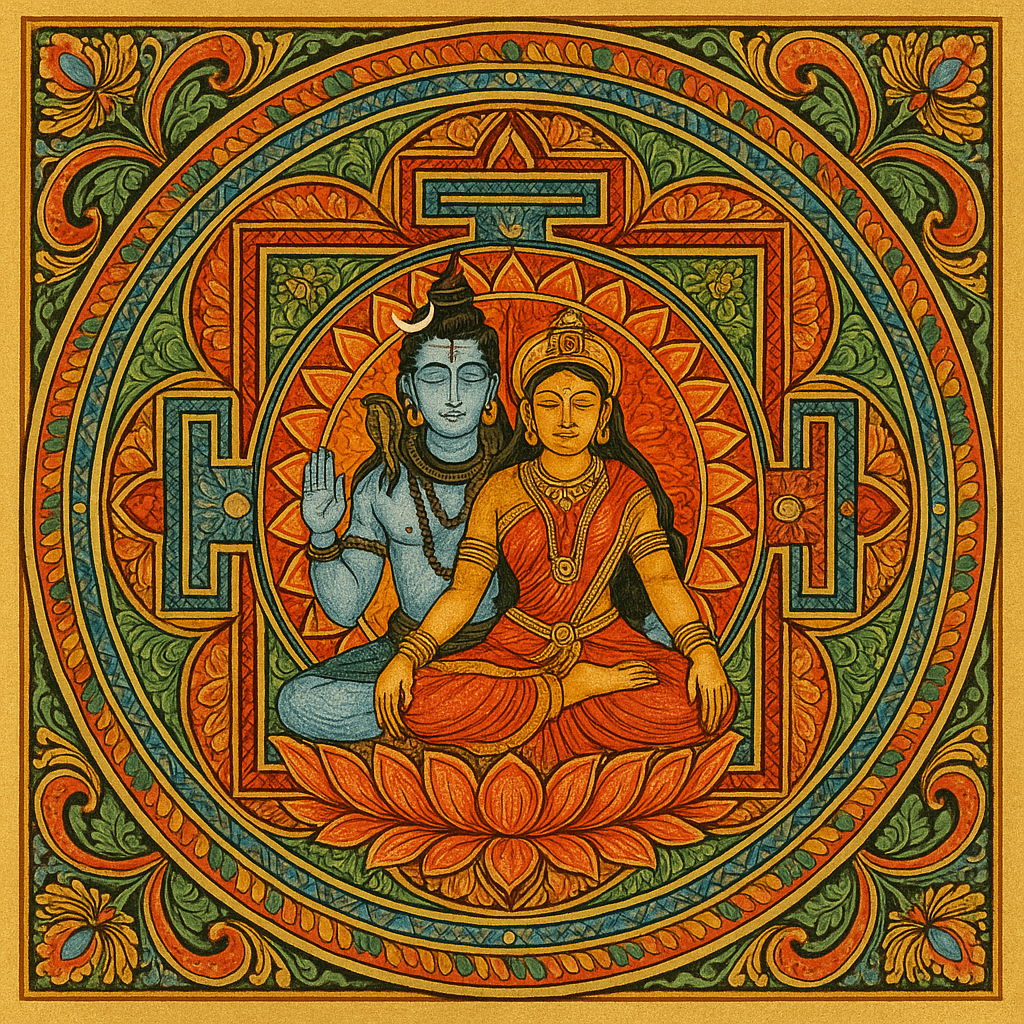
The word «tantra», of Sanskrit origin, appears in its Devanagari form as early as the 9th century. «Tantra» literally designates a spiritual «warp» or «fabric»: this term, synonymous with continuum, evokes the expansion of consciousness. Its exact definition became more precise in the 11th century in codified treatises, before being the subject of modern editions (ISBN 978…) and critical publications by authors such as André Padoux. The historical origin remains anchored in these early texts, the date of which forms the basis of all tantric philosophy.
How does Tantra fit into the holistic vision of ancient India?
In ancient India, tantrism emerged as an extension of Vedic Hinduism: its tantric philosophy views the universe as a chain of levels of consciousness, from the material to the spiritual. This cosmological tradition considers tantra as a global spiritual path, a way towards a higher level of expanded consciousness. Founded on a doctrine where every rite connects to the universal continuum, it posits the body and the mind as the basis of a sacred experience. This holistic vision, rich in meaning, links breath, meditation and ritual practice into a single inner universe.
Why does Tantrism go beyond the simple ritual or sexual dimension?
Tantrism transcends the simple ritual or sexual dimension by considering the body as a sacred temple where vital and sexual energy unite. Beyond sex or sexuality, it celebrates intimate connection and pleasure as gateways to the expansion of consciousness. Tantric practices, based on conscious touch and visualisation, transform every sensation into a sacred rite. Orgasms are no longer a mere endpoint, but a vector of sacred energy, awakening desire and propelling the practitioner towards a state of profound union between body, mind and the cosmos.
Vedic and Brahmanic roots: embryo of Tantra
How did Vedic rituals and hymns inspire Tantra?
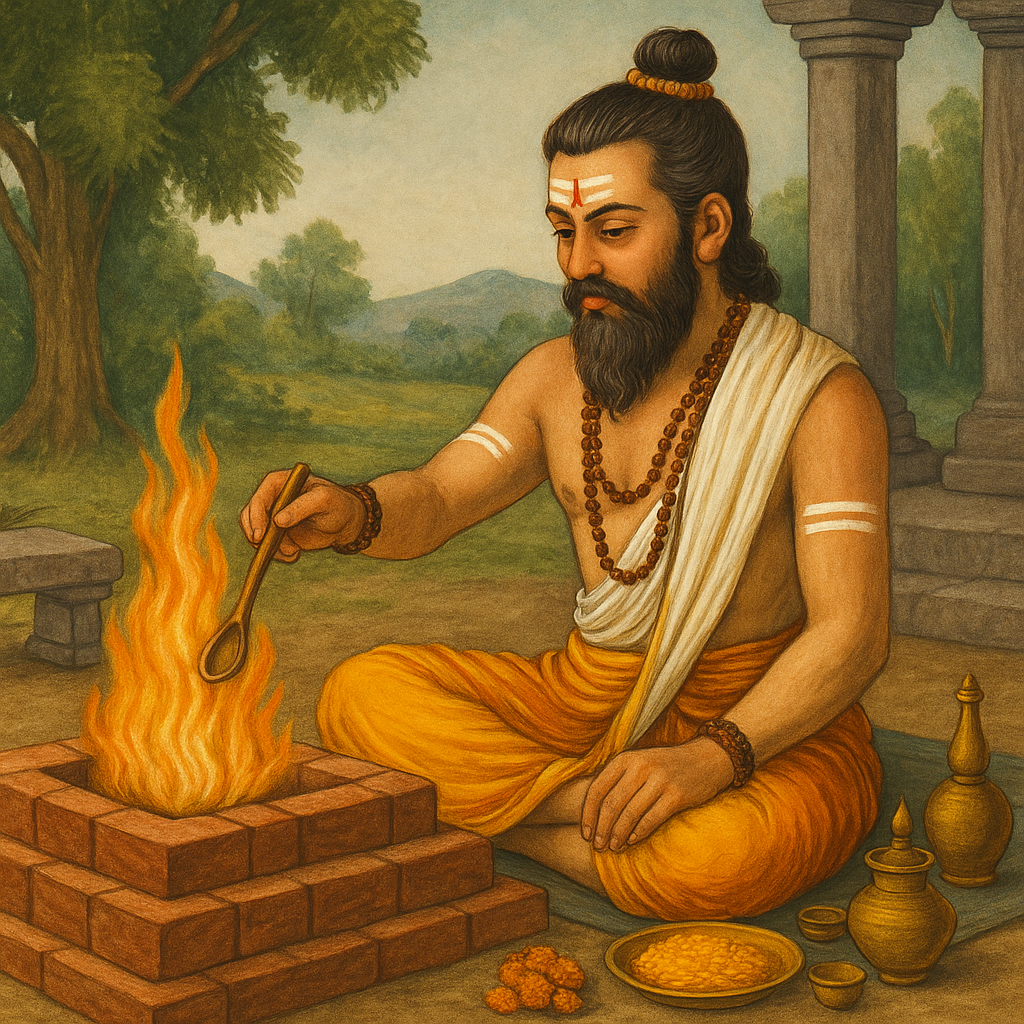
Vedic rituals, powerful ceremonies of Brahmanic worship, provided the foundation for tantric practices. The Vedic hymns, recited by the monk during each session, already structured precise rites combining sound and breath. Tantra reinterpreted these ceremonies as inner stages, transforming the practices into more intimate and dynamic experiences. Each ritual, whether an āvana (offering) or a transmitted mantra, was adapted to nourish vital energy within the body, thereby enriching the Vedic tradition with a more experiential and personal dimension.
Which Brahmanical myths are reinterpreted in the early Tantras?
The first tantras take up and reinterpret Brahmanic myths centred on the deity Shakti, mother goddess of cosmic energy. In these texts, each founding myth, originating from the ancient Vedic treatises, becomes a source of teaching on the union of masculine and feminine force. André Padoux highlights this symbolic reread in his studies, as does Daniel Odier, who reveals how these cults integrate an active cosmology. The tantras transform these narratives into living practices, offering a ritual mirror of universal creation to awaken the powerful Shakti within every initiate.
How does Tantra innovate in relation to the orthodox Vedic tradition?
Tantra innovates by offering a system that is both flexible and structured, where each rule is not restrictive but serves as a guide along a path of inner evolution. Unlike orthodox Vedic tradition, which follows rigid and uniform principles, Tantrism unfolds into varied branches, offering new methods suited to each aspirant. This path of Tantra prioritises the way personal experience activates vital energy, transforming ritual into a living and evolving practice, thereby opening the door to continuous metamorphosis.
Codification of the early texts: Saṃhitās, Āgamas and secret lineages
What are the chronological milestones for the appearance of the saṃhitās and āgamas?
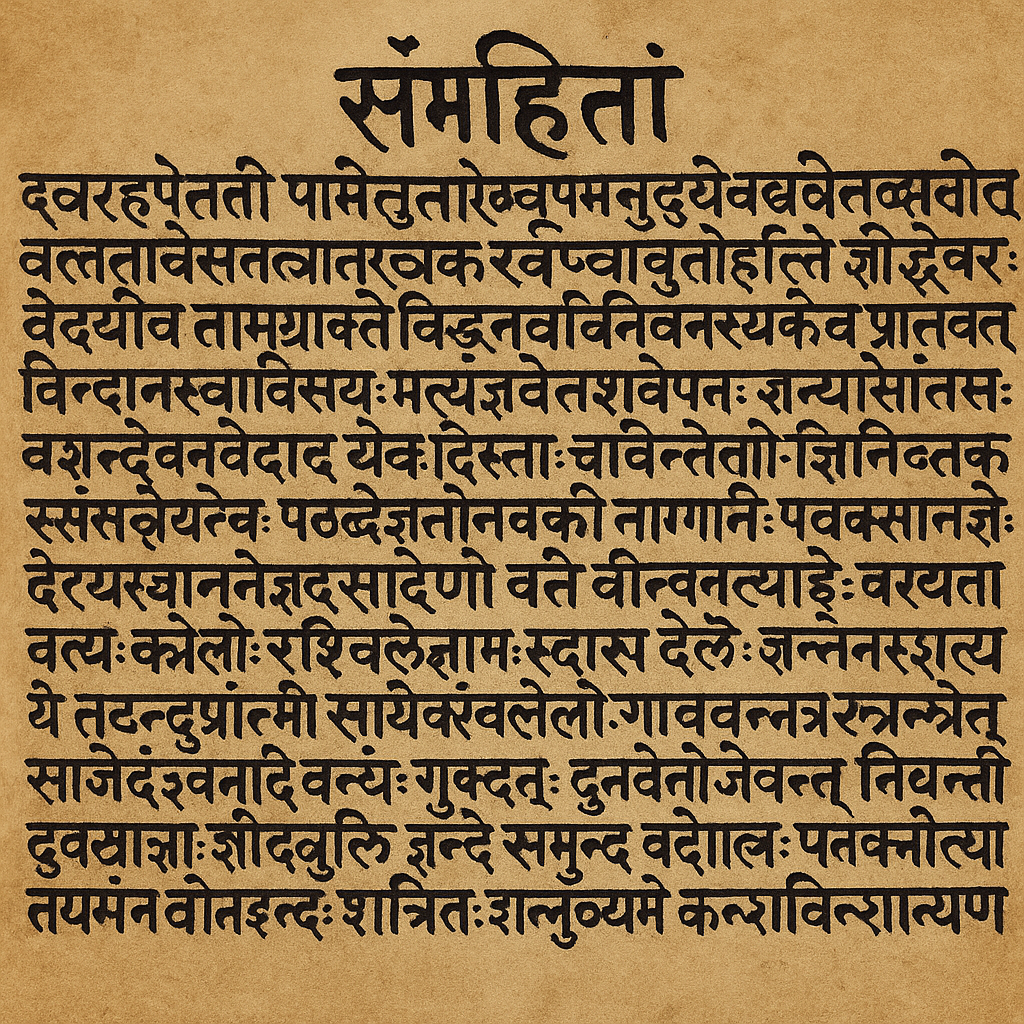
The founding texts of tantrism emerged progressively: the earliest saṃhitās appeared in the 6th century, laying the ritual foundations. In the 7th century, these writings structured themselves into more detailed āgamas, elaborating on mantras and protocol. Around the 9th century, new tantras enriched the corpus, integrating cosmology and philosophy. By the 11th century, the compilation of codified treatises provided a comprehensive account of the practice. These key dates trace the chronological evolution of a system whose history remains a fascinating subject of study.
Who were the pioneer lineages (Kapalikas, Kaula, etc.) and how did they transmit their teachings?
Pioneering lineages, such as the Kapalikas and the Kaula, structured their schools around an enlightened master, where initiated men and women followed a secret teaching. Each centre preserved oral and manuscript sources, studied by specialists such as André Padoux, while Daniel Odier analyses these transmissions in his works. The master guided the initiates through rites and meditations, ensuring a living transmission of the tantras. Thus, these lineages laid the foundations of a rigorous esoteric knowledge, perpetuated within monastic and lay communities.
How did writing down formalise mantras, yantras and rituals?
The transcription of tantric practices has established a precise code for each rite: mantras are noted according to phonetic rules, yantras are described step-by-step in the texts, and each ritualised protocol becomes a methodical exercise. This formalisation, catalogued in the tantras and saṃhitās, offers a clear guide for visualisation and practice. Tantric texts thus detail the methods, rites and practices, ensuring the coherence and faithful transmission of the teachings, while enabling each practitioner to follow an evolutionary path.
Diffusion and medieval transformations: from the subcontinent to North Asia
How did Vajrayana Buddhism adapt and integrate Tantra?
Vajrayāna Buddhism, often called tantric Buddhism or diamond Buddhism, integrated Tantra by adapting its rituals and mantras to its teachings. Vajrayāna tantric schools, such as that of the Kalachakra tantra, merged esoteric cosmology and practical protocol, creating a unique system. Each school codifies its practices in dedicated texts, ensuring the transmission of a structured teaching where visualisation and ritual become direct means of awakening. This synthesis has shaped adamantine Buddhism.
What regional adaptations in Southeast Asia and Tibet?
In South-East Asia, Tantra takes on a syncretic form where rituals and mantras adapt to local cults, enriching tantric practice with elements of animist reality. In Tibet, Tantra becomes a structured visualisation tool: each ritual embodies an aspect of the cosmos, transforming the place of practice into a living mandala. These adaptations give tantrism a new meaning, crossing borders and eras to establish itself as a universal experience. Even in Japan, under Tendai and Shingon, Tantra preserves this path of expansion while reinterpreting its techniques according to the local spiritual context.
What are the early echoes of Tantra in China and Japan (Shingon, Tendai)?
At the turn of the 7th century, Chinese monks brought back the first tantras via the Silk Road, ushering in an esoteric cult blending meditation and ritual. In Japan, the Shingon and Tendai schools welcomed these teachings: Japanese specialists translated the texts and adapted the rituals to their tradition. Shingon favoured the visualisation of the mandala, whilst Tendai integrated mantras and ceremonies into its monasteries. These founding echoes implanted tantrism in East Asia, laying the foundations for a living and locally rooted practice.
Renaissance and Neo-Tantra: the rediscovery through direct experience
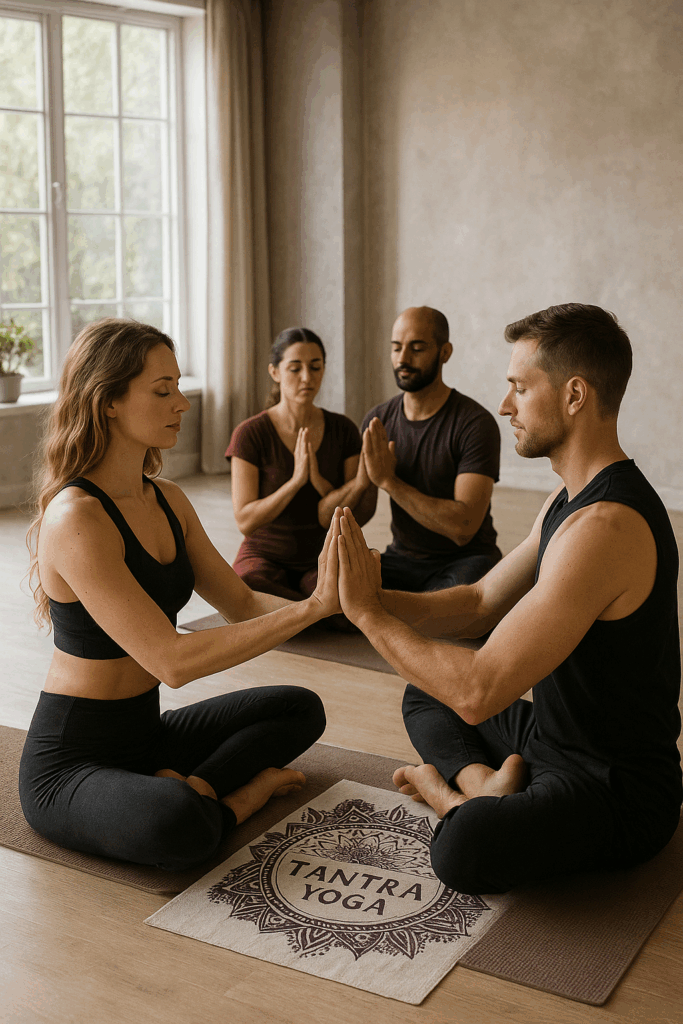
How did the counterculture of the 1960s redefine Tantra in the West?
In the 1960s, Westerners, notably in New York and France, discovered Tantra via the counterculture and the New Age movement. The first publications and articles translated these esoteric practices into a mainstream topic of discussion. Followers sought to merge meditation, sacred sexuality and spiritual awakening, far from codified rituals. This revival popularised experiential workshops, redefining Tantra as a path of freedom and personal expansion. Thus, Tantra became an alternative lifestyle, blending love, vital energy and a path of consciousness, adapted to an era in search of meaning.
Why in-person gatherings remain at the heart of Tantra
In a world where everything seems capable of being experienced behind a screen, Tantra serves as a reminder of the obvious: certain experiences can only be transmitted in person. Online training allows access to theoretical information, but it can never replace the power of a transmission lived in the body, through the breath, the gaze, and shared energetic vibration. Tantra is an embodied path: it is discovered through guided practices, rituals experienced together, and an immersion that opens doors impossible to cross alone in front of a computer.
The revival of Tantra happens through real-life encounters
Neo-Tantra developed in the 20th century with the idea of bringing these teachings to a modern audience. Yet, what continues to make it so rich today are in-person workshops and retreats. These spaces create a secure environment where trust, touch, breathing and energy flow naturally between participants. It is within this shared intensity that true breakthroughs are experienced: a reconnection with the deeper self, an opening of the heart and an experience of the sacred in everyday life. More than a simple learning experience, an in-person training course becomes a transformation in its own right.
Heritage, research and future perspectives
Which scientific discoveries enhance the credibility of Tantra?
Recent research in neuroscience and experimental psychology is examining the effects of Tantra on levels of consciousness and body awareness. Studies are measuring the impact of tantric rituals on heart rate variability and mindfulness, revealing a modulation of brain activity linked to universal consciousness. This scientific knowledge sheds light on the subtle reality of the practices, experimentally validating their benefits. Visualisation and tantric meditation protocols, tested in vivo, are reinforcing Tantra's credibility as a path to expanding consciousness and harmonising the mind and body.
How are AI, virtual reality and the metaverse already influencing certain practices?
New technologies are transforming Tantra: AI personalises rituals by instantly analysing the initiate's energy level and needs, while virtual reality immerses the practitioner completely, recreating mandalas and ceremonies. In the metaverse, every visualisation system makes it possible to explore the present moment with unprecedented intensity. These innovative means extend the tantric experience beyond the physical body, fostering a deep connection between consciousness and the universe. AI, VR and the metaverse are thus becoming valuable tools for practising and transmitting the path of Tantra in an interactive and evolving way.
What global trends can be anticipated for Tantra beyond 2025?
The coming decades will see the evolution of Tantra unfold on a global scale, with an enhanced development of hybrid training (in-person/digital) and the expansion of dedicated immersive universes. Pedagogical plans will adapt, integrating augmented reality and cross-cultural exchanges to enrich the spiritual path. An increasing fusion between ancestral traditions and innovations is anticipated, fostering a holistic experience accessible to all. This expansion promises to structure a new age of Tantra, where the spiritual path will flourish in a global context, connecting every practitioner to the universe and to their own inner potential.
- Share