The art of listening to oneself, respecting one’s limits and regaining the freedom of a true “Oui”.
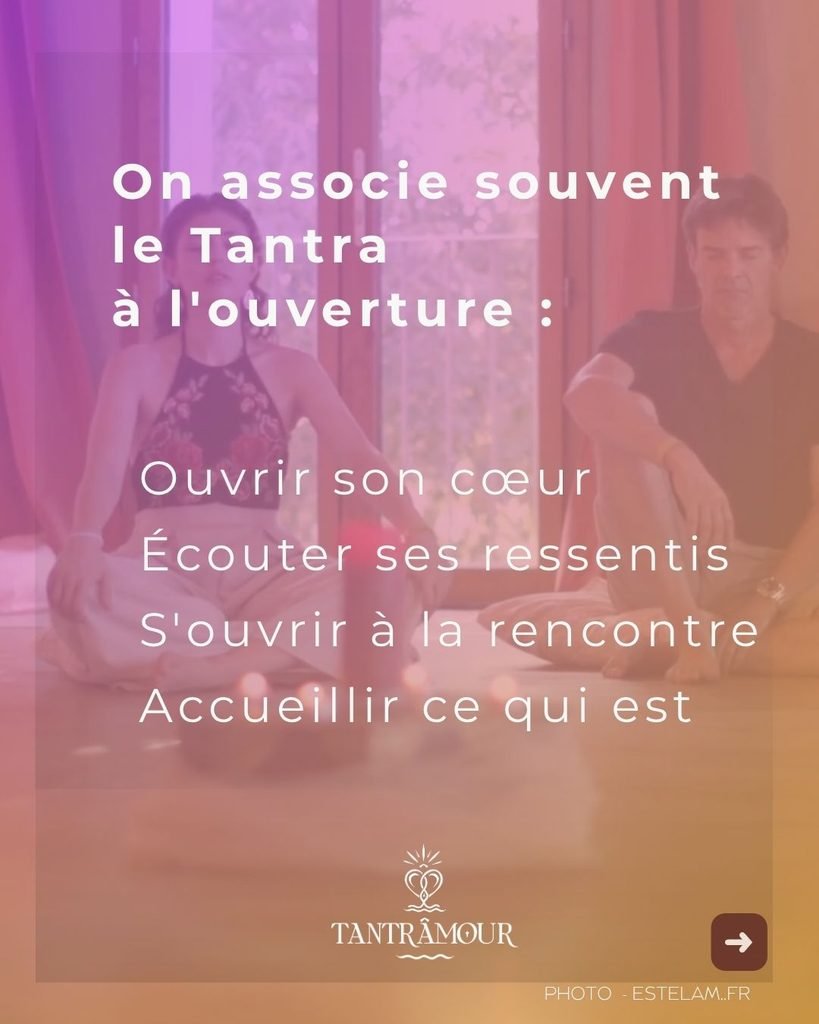
Tantra is often associated with openness. Opening our hearts, welcoming our emotions, exploring new experiences, and being available to meet ourselves and others. This invitation to openness is valuable, as it encourages us to break out of our habitual patterns, broaden our perspective, and discover dimensions of ourselves that we sometimes still know little about.
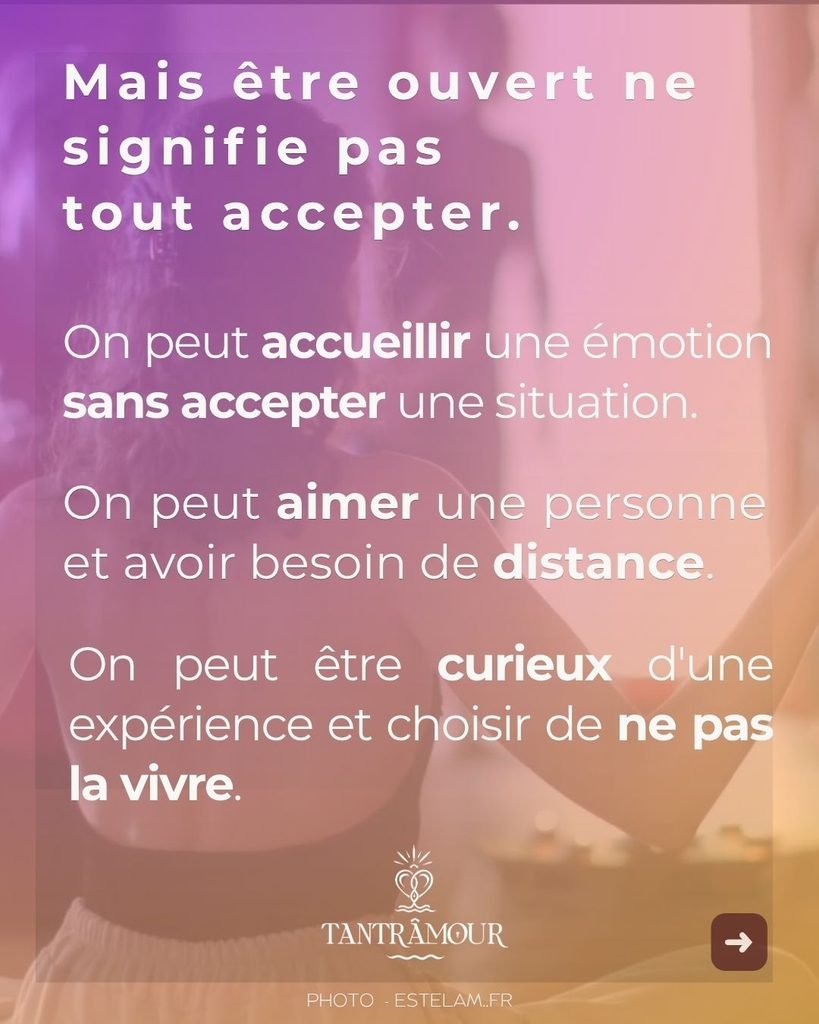
But behind this beautiful aspiration lies a confusion that deserves clarification: Opening up does not mean accepting everything, and walking in the Tantra does not consist of constantly pushing one’s limits.
It even happens that one of the most profound experiences on this path is to discover that we have the right to say NO, to slow down, to withdraw, or simply to not know.
Because true openness does not arise from the obligation to welcome. It takes root in the freedom to choose.
The opening, an invitation to encounter life in all its diversity
In our daily lives, we naturally develop habits, preferences, defenses, and sometimes mechanisms that distance us from certain experiences. We may have learned to hold back our emotions, avoid conflict, control how we feel, or conform to what others expect of us.
Tantra invites us to take a more conscious approach to these processes. It proposes that we return to the body, welcome our sensations, encounter our emotions, and observe with curiosity how we enter into relationship with the world.
This openness can take very simple forms. Dare to express an emotion that you have been holding back for a long time, accept a compliment without minimizing it, let yourself be touched by the beauty of a landscape, share a moment of silence with another person, or discover a new way of moving and breathing.
It’s not necessarily about having extraordinary experiences. It’s more about finding a quality of presence that allows us to feel more of what is already there.
However, this readiness to live should never become an obligation to live, to accept or to accept everything.
When the desire to open up leads us away from ourselves
There is a paradox that we sometimes encounter in the fields of personal development and spirituality: by trying to overcome our fears, we can end up no longer listening to our true needs.
We can accept a proposal because we believe it will make us grow, while part of us does not feel ready. We can say YES to not disappoint, to belong to the group, to meet the expectation of a partner, or because we imagine that a person further along on their spiritual path should be able to accept everything.
Sometimes this pressure doesn’t even come from outside. We impose it on ourselves, with the idea that our hesitations are resistances to overcome or that our limits indicate a lack of openness.
Yet, A limit is not necessarily a fear to be overcome. It can be a very accurate expression of what we need at this moment.
It is possible to deeply love someone and feel the need to distance oneself. It is possible to be curious about an experience without wanting to live it out. It is possible to feel intense emotion without immediately wanting to share it.
Learning to recognize these nuances is an essential part of the path of consciousness.
The body, a space for listening and discernment
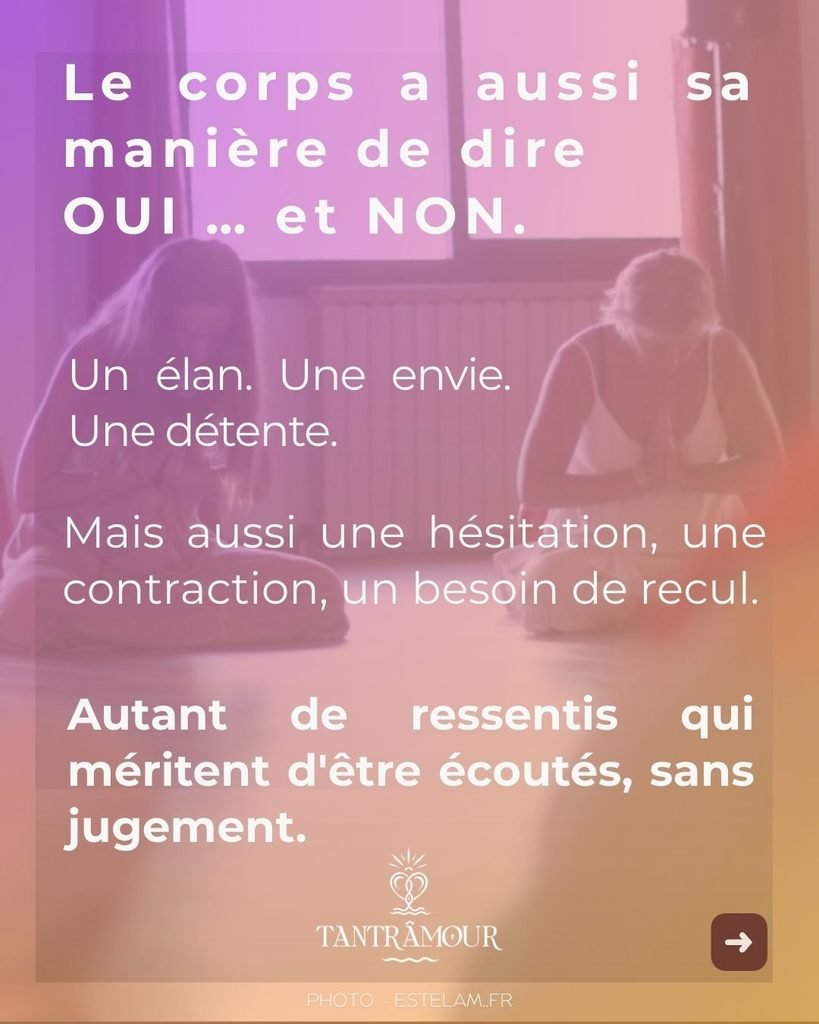
Our body is fully involved in the way we perceive the world. Well before we have found the words to describe a situation, we can feel a surge of energy, a relaxation, a hesitation, tension, or a need for a step back.
These bodily manifestations are valuable invitations to listen. They encourage us to slow down and to ask ourselves what is really happening within us.
But they are not always definitive answers. A contraction can accompany fear, emotion, a memory, or simply a passing discomfort. A sense of relaxation does not necessarily mean that we want to continue an experience.
Listening to the body therefore requires sensitivity and discernment. It does not consist in turning every sensation into a verdict, but in developing a more attentive and respectful relationship with what we experience.
In a tantric practice, this can mean taking a few moments to breathe before responding to a proposal, observing what we feel in an interaction, asking to slow down, or choosing to simply remain present without participating in an experience.
Little by little, we learn to distinguish what we truly desire from what we think we should desire.
And this distinction can profoundly transform our relationship with ourselves.
Consent, far beyond a simple YES or NO
Consent is sometimes presented as a rule to be followed before a practice or interaction. This is obviously essential, but its scope is much deeper.
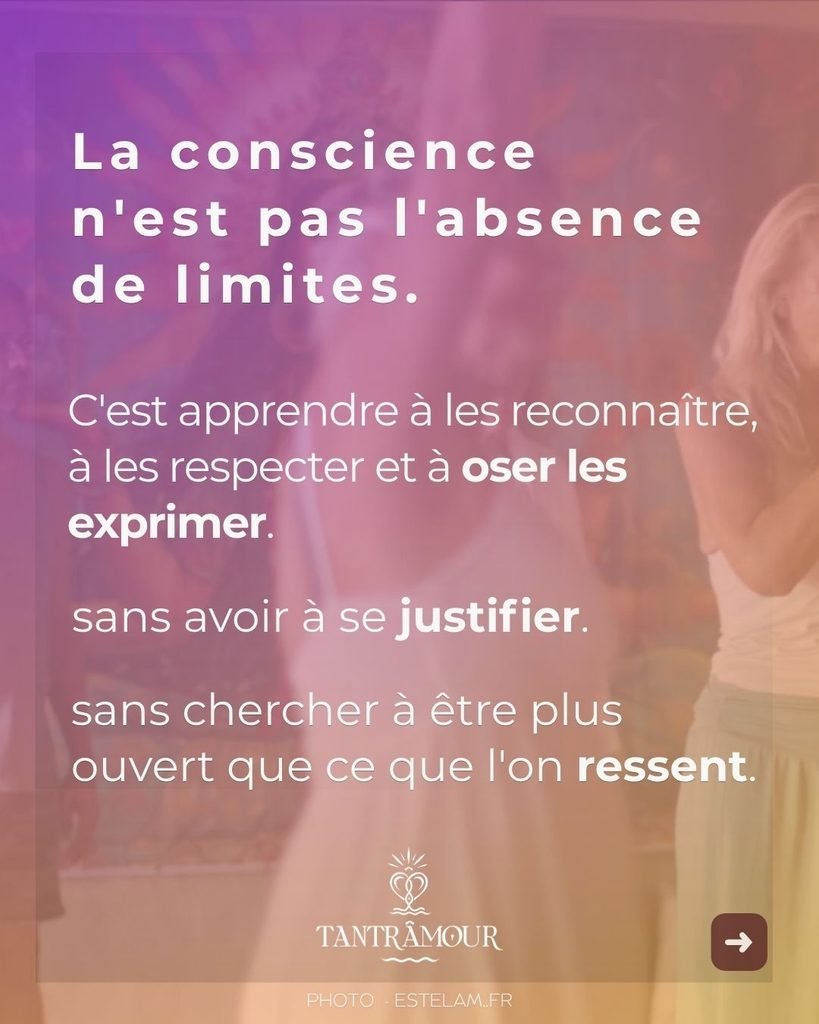
Consent is not just saying “yes”. It is being able to choose freely, with sufficient information, without pressure or fear of the consequences of a refusal.
It is also knowing that our choices can evolve.
We can accept a proposal and then discover, a few minutes later, that it no longer suits us. We can wish to change a practice, ask for more space, or decide to stop.
True consent remains alive. It accompanies the experience rather than being considered as definitively acquired.
This freedom also applies to the person who receives a NO. Learning to hear a boundary without seeking to convince, negotiate, or interpret the rejection as a personal rejection is an equally important relational practice.
Because consent does not depend solely on one person’s ability to express their limits; it also depends on the other person’s ability to accept and respect them.
When everyone knows that their choice will be heard, the relationship can become a space of trust rather than a place of expectations to be met.
Saying NO without closing your heart
For many of us, saying NO is not always easy.
Sometimes we grow up with the idea that we need to be kind, available, accommodating, not to upset others or make their needs take priority over ours.
In our affective relationships, whether friendly or professional, this difficulty can lead us to accept situations that are not really suited to us.
We then end up confusing generosity with self-effacement, love with permanent availability, or openness with a lack of boundaries.
Yet it is possible to say NO with tenderness, with respect, and even with love.
Saying «I don’t want to live through this experience,» «I need time,» «I’d rather stay out of it» or «I don’t feel available today» does not necessarily mean rejecting the other.
Sometimes it’s simply about taking care of the relationship by adding more truth to it.
And when we stop forcing ourselves to meet expectations, we can discover a more sincere way of being together, where each of us exists fully, with all our impulses, hesitations, desires, and limitations.
In our workshops, we encourage the freedom to choose an experience to live.
Within TantrÂmour, this attention to individual freedom occupies an essential place in our approach to accompanying practices.
We want to create spaces where everyone can explore at their own pace, without having to demonstrate their openness, courage, or level of experience.
A proposal remains an invitation. It can be accepted, adapted, or rejected. A person may need to observe before participating, take a step back, modify an interaction, or stop during the practice.
We attach importance to this possibility of choice, because it allows us to develop a confidence that is not based on the obligation to succeed in an experience or to go beyond what we feel.
And sometimes something very touching happens when a person discovers that she can say no without losing her place in the group, without disappointing others and without having to justify herself.
What seemed to be a closure then becomes a deeper encounter with oneself.
It is no longer about matching an image of an open, conscious or spiritual person. It becomes possible to simply be there, with what is present, in all its humanity.
Spirituality does not ask us to constantly surpass ourselves.
In some representations of spirituality, personal evolution seems to be associated with an ever-increasing openness, a growing capacity for acceptance, or the gradual disappearance of our resistances.
But an embodied spirituality cannot ask us to distance ourselves from our feelings in order to conform to an ideal.
On the contrary, it invites us to live more fully our human experience, with its movements of expansion and withdrawal, its ups and downs, its uncertainties and questions.
There are moments to open up, to meet the unknown, and to take a new step. And there are moments to gather ourselves, preserve our space, recognize a boundary, or simply rest.
These movements do not oppose each other. Both of them contribute to the balance of life.
Like breathing, which naturally alternates between inspiration and expiration, our relationship with the world needs to be able to expand and contract.
The opening is not intended to become a permanent state. It can be a free movement, which respects our rhythm and the truth of the moment.

When my NO is free, my YES becomes alive
Ultimately, this path leads us back to an essential question: what place do we give to our own truth in our relationships?
Are we capable of recognizing our desires without rushing to satisfy them? Of accepting our hesitations without judging them? Of expressing a limit without feeling guilty? Of hearing the other’s limit without feeling rejected?
These apprenticeships are not limited to Tantra courses. They affect our daily lives, our relationships with our partners, our friendships, our family, and all the situations in which we are faced with making choices.
They invite us to build relationships where closeness does not require giving up on ourselves, where love leaves room for difference, and where meeting can be lived without obligation.
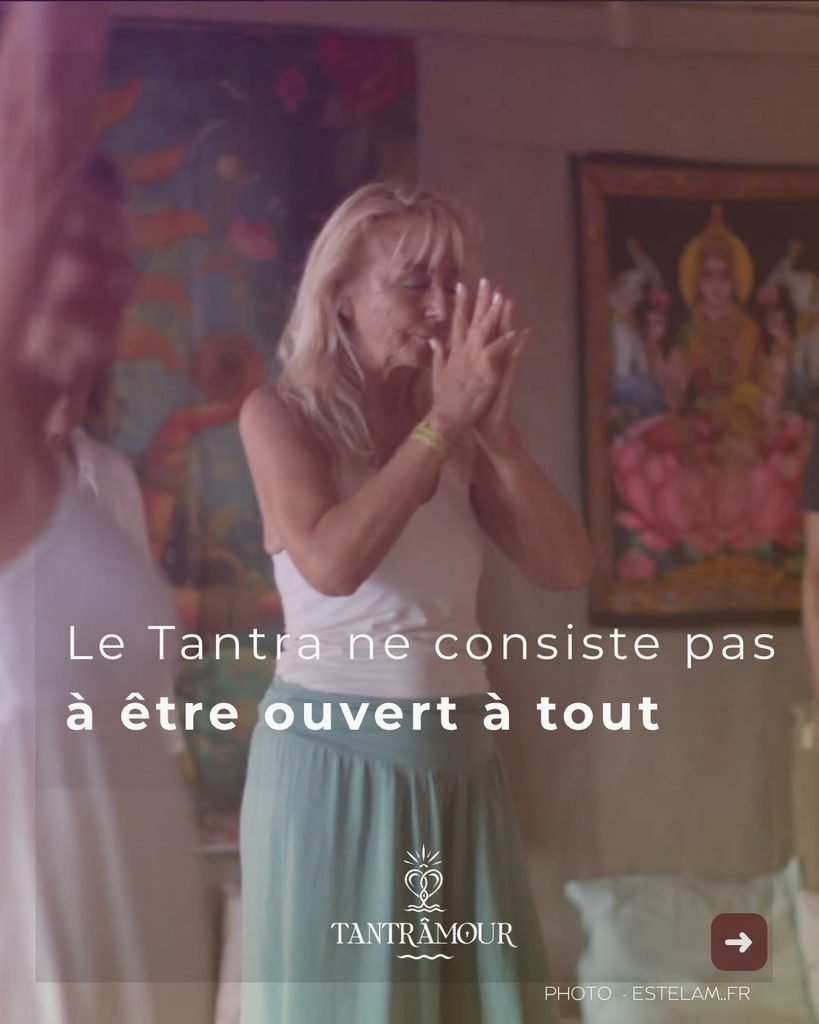
For us, Tantra is not a path that teaches us to say “yes” to everything.
It is a path that invites us to become more present, more conscious, and more free in the way we encounter life.
And sometimes, this freedom begins with a very simple word, spoken with sincerity.
NO.
Not to close oneself to the world, but to remain faithful to what is just for oneself.
Because it is when I discover that I can truly say NO that my YES becomes finally free.
An "yes" that no longer seeks to please, to meet an expectation, or to prove anything.
A YES that comes from me. Free, sincere and deeply alive.
Sabryna & ShivaChris — TantrÂmour
Tantra is about fully inhabiting the world, not escaping it.
- Share