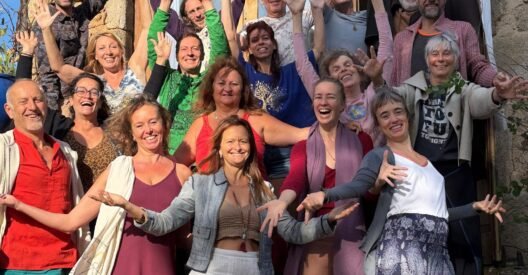
The word «Tantra» often evokes sexuality... but the reality is much broader.
When the word Tantra is uttered, many people immediately imagine sexual practices, mysterious rituals or experiences reserved for a select few. This association is so widespread that, for many, it has become the very definition of Tantra. However, this view represents only a tiny part of an age-old tradition, the The depth, richness, and scope extend far beyond the realm of sexuality.
Tantra is first and foremost a path of awareness, an invitation to live more fully, to inhabit one's body more, to open one's heart and to develop a deeper presence to oneself, to others and to life.
A spiritual tradition thousands of years old
Born in India over two thousand years ago, Tantra is a body of philosophical, spiritual, and practices that have profoundly influenced Hinduism, Tibetan Buddhism, yoga, and many contemplative traditions.
In its origin, Tantra does not speak of sexuality. It speaks of consciousness. It teaches that everything that makes up our human experience – the body, emotions, thoughts, energy, relationships, nature – can become a path of awakening and self-knowledge.
Where some traditions have sometimes sought to elevate themselves by distancing themselves from the world, Tantra, on the contrary, proposes to fully embrace existence in all its dimensions.
The body is not an obstacle: it becomes an ally.
In our society, we often live a lot in our heads. We analyse, plan, anticipate, and control. The body sometimes becomes a mere vehicle, one that is rarely listened to.
Tantra proposes a radical change of perspective. The body is no longer seen as an obstacle to overcome, but as a space of wisdom to be listened to. Through breathing, movement, meditation, presence, conscious touch or certain energy practices, it becomes possible to reconnect with the sensations, emotions and natural intelligence of life that expresses itself through us.
This reconnection is often one of the first discoveries for people new to Tantra.
Tantra speaks more about presence than sexuality.
Sexuality can exist in certain Tantric lineages, but it is neither its centre nor its ultimate aim.
In most contemporary Tantra workshops and festivals, the practices offered primarily concern presence, body awareness, authentic communication, heart opening, meditation, movement, breath, and the relationship with oneself and others.
Many participants are surprised to find that’They spend more time meditating, breathing, dancing, sharing, listening or exploring their emotions than talking about sexuality.
The true subject of Tantra is less about sex than it is about the quality of presence we bring to every moment of our lives.
Learning to meet others differently
One of the great teachings of Tantra is rediscovering human connection.
In a world where exchanges are often rapid, superficial, or conditioned by social roles, Tantra invites us to to slow down and to meet others with greater awareness. Learning to truly look, to listen deeply, to express one's feelings, to respect one's limits and those of others then becomes an extraordinarily rich field of exploration.
These simple experiences often create a sense of connection and authenticity that many people have long been seeking without knowing how to access it.
A space where everyone remains free
Another common preconception is to imagine that attending a Tantra workshop necessarily involves certain practices or a particular level of commitment.
The reality is quite different.
In a serious context, the notions of consent, respect, individual liberty, and personal responsibility are central. Everyone is free to participate in a practice or not, to adapt the suggestions at their own pace, and to respect what feels right for them.
Tantra is not an invitation to go beyond your limits. It is an invitation to know them better and to honour them.
Why is Tantra so popular today?
If Tantra has been experiencing such a boom for several years, it's probably because it meets deeply contemporary needs.
In a society marked by permanent acceleration, digital hyperconnectivity, and pressure to perform, many people feel the need to slow down, rediscover meaning, recreate authentic human connection, and reconnect with their sensitive side.
Tantra offers precisely this space: a place where one can shed their masks, return to their body, listen to their heart, breathe more deeply, and rediscover the joy of being fully alive.
More than a practice: a way of being in the world
Fundamentally, Tantra isn't something you do. It's a way of inhabiting life.
It's learning to be present to what is there. Feel more. Love more. Listen more. Live more.
It is transforming ordinary moments into conscious experiences and discovering that the sacred is not separate from our daily lives but can reveal itself in a glance, a breath, an encounter, a sunset, or a simple moment of presence.
Perhaps this, ultimately, is the greatest secret of Tantra: to remind us that life itself can become a path of awakening, celebration, and love.
- Share