It is very important to us to share what tantra is in a simple, clear and accessible way for everyone.
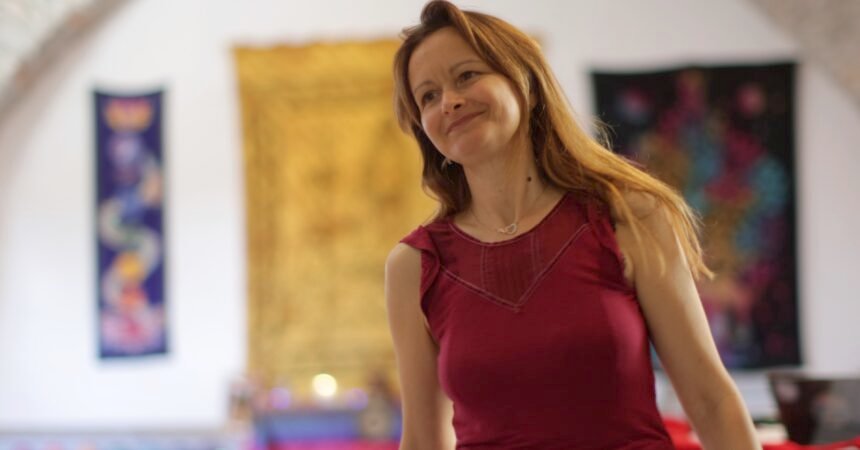
This piece, written by Sabryna, concretely sets out «everything you always wanted to know about Tantra without ever daring to ask“.“
Enjoy!
There are few places where we can connect with what matters most
The word «Tantra» often carries fantasies or fears. For those who are not familiar with this approach, it is loaded with connotations surrounding sex and can provoke rejection. And yet... in our Western society, there are few places where sexuality can be approached in a simple and sacred way. There are few places where we can return to our bodies and our sensations. There are few places where we can connect with our essence: the awareness of who we truly are.
Our Judeo-Christian upbringing and conditioning have very often cut us off from desire, from our genitalia. Or the opposite, when this «overflow» is difficult to manage. The word «sex» is taboo and the mere fact of saying it out loud can provoke embarrassment, disgust or fear.
Conditioning & freedom
The daily emergencies disconnect us from our inner life: for beyond the outer tumult of everyday life and multiple demands, we have a body that is there unconditionally. And this body is endowed with marvellous faculties: thanks to it we walk, we breathe. Thanks to it also we think, we feel. Emotions and sensations pass through us, whether they are pleasant or unpleasant.
But we didn't learn it at school. When it comes to sex education, secondary school biology teachers very often devote only a single session even though the law recommends at least 3. Is there no resource centre to find out «how you make love»? At the level of the body and emotions, it's schools
alternatives (such as Steiner or Montessori) that invite children to connect with this. Some schools offer mindfulness meditation workshops for example, but it is still rare.
Very often, we haven't learned it in our family environment either. Talking about sexuality within the family unit is often skewed by stories
from lineages, transmitting taboos about sexuality, negative beliefs, or even family secrets, hidden in the unconscious. And as for the body and emotions, the child's spontaneous expressions (anger or tears, for example) are not always welcomed with kindness.
And yet… what is most important? To be loyal to our conditioning, to stay in our comfort zone even if it is not ideal, to respond to outside demands to «please» people or… quite simply… to «live»! It is possible to return to our inner world in order to truly exist, while remaining connected to the outside world without being rejected. Our current Western world, with its acceleration of time, increasingly intense pressures, limitless consumption, and the exacerbated values of ’having«, shows us that it is urgent to become aware of Being… who we are!
Tantra is a magnificent path of discovery and liberation. It is one of the rare spaces where the body, sensations and sexuality are approached in a way
simple, beautiful, sacred, with respect and kindness. Having remained a secret for a long time, this millennial approach is arriving in the West and has been gently unfolding for about thirty years.
Here is a personal synthesis that may shed light on what Tantra is, in my opinion.
The word «tantra» means: the “weft”, that which connects things (like the weave of a fabric). This approach stems from ancient texts originating in tantric cults dating back even before Buddhism and Hinduism. The hedonistic side of the Kamasutra is often confused with the approach of Tantrism, which is completely different. A basic principle of tantra is that when we speak of sexual union, it is about the union of the body and the mind, according to the tantric and esoteric language of sexuality. We find the notion of the quest for Unity in a dual world.
From duality to Unity
A simple observation of our surrounding world shows us that everything (living or not) is composed of two polarities: up-down; hot-cold; negative-positive; day-night; heads-tails; yin-yang and... feminine-masculine. And this applies to human beings too!
The teachings derived from Tantrism, as well as many other philosophical and spiritual approaches (Taoism, Buddhism, etc.), evoke the two polarities of being. Along this axis, Tantrism is the affirmation of non-duality, beyond apparent duality. For beyond the positive and the negative, there is the neutral, our centre. This is «the Divine within us».
A quantum vision of the universe
According to tantra, consciousness and energy are present everywhere in the universe, from the smallest atom to the largest planet. Everything is consciousness, everything is energy. Tantra is a quantum vision of the universe: it considers that the external world (objects) and observers (subjects) share the same ultimate nature, acting as an inseparable whole. This is the principle of unity in diversity and diversity in unity.
Science has shown that matter is an interplay of forces that obey laws, such as those of gravitation, expansion or weightlessness. In the tantric vision, these are manifestations of universal Consciousness, which could be defined as a static and inert male principle, incapable of manifesting itself without the energy embodied by the dynamic female principle. The interaction between these two principles is permanent: like the positive and the negative, the even and the odd, day and night, life, death, the dualism of yang and yin. Just as in quantum physics, there is an antiparticle for every particle, just as there is no matter without antimatter.
Tantra views this mythical couple by representing them in the form of a god and a goddess: the two are as one. The one is the mirror of the other. It is Shiva and Shakti reunited. Tantra invites everyone to connect with their vital energy and make it circulate. For when vital energy meets matter, it rises in vibration. It is the quantum leap. The awakening of Kundalini. The laws of gravitation and attraction then take on a different flavour. We step out of the world of attraction and enter the world of quantum probabilities. The Light hidden at the heart of every cell of the shadow body has awakened and revealed itself.
The sacred feminine & masculine
An essential element of Tantrism is that the feminine principle («shakti») is the very symbol of wisdom. And as mentioned above, it is only effective through union, and more specifically through the act of this union, brought about by the masculine element («shiva»). Tantric practices invite one to experience within oneself this union of the feminine with the masculine. It is a path of self-knowledge.
First of all, it is a matter of identifying one's feminine and masculine sides.
What does it mean for a man to have the feminine within himself?
Perhaps embracing one's vulnerability and feeling sensitive and tender isn't «losing one's masculinity» after all?! Perhaps it's quite the opposite! For it would seem that these values reinforce intrinsic male qualities... what could be more reassuring and attractive to a woman on her journey than meeting a man at peace, in his power and his vulnerability, who owns both his strengths and his weaknesses... which then become a strength!
For a woman, having a masculine side within herself is perhaps easier to identify: in our Western society, with its ever-accelerating pace where “doing” leaves little room for “being”, the space for the feminine seems narrow. Remaining a “woman” in everyday life is no mean feat when you have to hold your own on all fronts: at work, at home, as a partner, mother, lover, friend, working girl, etc. How can one avoid being overwhelmed by this need to “keep going”, “act”, and “control”… this “mental load” that people are starting to talk about.
Tantra invites us to revisit and awaken our virtuous, essential, sacred feminine and masculine parts! For a feminine of being, gentle, sensitive, intuitive
and a protective and tender masculine… such is the equation in Je(u).
According to the tantric approach, reconciling these two founding principles within oneself makes it possible to harmonise body, emotions and thoughts, in order to exist to the rhythm of one's pacified heart. This harmonious arrangement also fosters a more authentic connection with others, rooted in kindness and wonder. This is the heart-centred relationship.
«One sees clearly only with the heart, what is essential is invisible to the eye,» said «The Little Prince». It is thus a matter of «coupling» first with oneself and symbolically revealing one's own circle - full, complete, nourished, autonomous - in order to better meet the circle of the other afterwards, which is necessarily different and complementary. This conscious approach allows the synergy of two circles. This is the Alliance - for a sacred dimension of the relationship.
The body … place of the Self
The human body is at the centre of tantric philosophy: it is a universe in itself, it contains universality. God – or universal energy – is within oneself and not on the outside. It is in this place that our existential vitality resides. And it is by connecting as often as possible to this centre, this divine core which is within each of us, that we can feel reconciled. It is a path to liberation.
It seems obvious, but it is worth pointing out: with a few exceptions, we are all the result of coitus, and of pleasure. In tantric philosophy, pleasure is not condemned or fought against. This is in contrast to our Western world, in which the great difficulty is accepting that we are
primarily beings of desire, and to embrace pleasure.
Libido and pleasure are a path to liberation. It is a necessity! The tantrika (one who practises tantra) proclaims how fortunate we are to be incarnated in a body. We too often forget the complexity of the human body and the gift that life is, created by the meeting of a sperm and an egg! It is a stroke of luck. All of humanity holds this wisdom of the union of body and mind, and this wisdom is within each of us.
This is the major difference from the Judeo-Christian and Muslim monotheistic traditions, for which pleasure is something that must be fought against.
On the importance of the setting
Tantrism is a form of initiation. It cannot be “delivered” as is because it is about experimentation: outside its context, it loses all meaning. Hence the importance of the framework: it goes without saying. Because in our society, tantra can obviously lead to sexual abuses and stray from its initial essence.
That is why, in most workshops or classes, boundaries are set to prevent these excesses. Tantra certainly touches upon sexual energy. It is our life force. However, the aim is to channel it consciously, in order to feel more alive. It is a powerful path of personal development, self-discovery, and liberation.
The rollout of tantra in the West
At the very start of the Age of Aquarius, the arrival of Tantra in the West is self-evident. It is inexorable. After nearly 2,000 years of repression of the body and sexuality conveyed by Judeo-Christian religions, we are in an era where it is necessary for this knowledge to be shared so that the world's consciousness may evolve. So that each of us may taste this freedom of being, in consciousness and with respect for oneself and for the other. For the unfolding of
the source of love.
Text written by Sabryna in 2017
It's best to live the experience!
To experience neo-Tantra safely and benevolently (within a framework of respect and no acting out): you are invited to the TantrÂmour immersions.
TantrÂmour workshops take place in Provence (PACA region, Vaucluse: at La Minoterie near Mérindol, 35 minutes from Aix-en-Provence TGV or Avignon TGV station); in Occitania (at Le Hameau de l’Étoile, a seminar venue 40 minutes from Montpellier); in Alsace (at Les Jardins du Nideck, 35 minutes from Strasbourg).
- Share